Your Ideas Are Your Most Valuable Assets
In today’s economy, what you own isn’t just about physical things like buildings or machines. It’s about your ideas, your brand, your inventions, and your creative works. This is your Intellectual Property, or IP, and it’s often the most valuable asset your business has. Protecting it isn’t just a legal formality; it’s a fundamental business necessity.
This guide is the heart of our “Intellectual Property” service hub. We’re going to give you a practical, real-world tour of how to protect your IP, with a special focus on our home turf of Macau and the unique opportunities in the Portuguese-Speaking Countries (PSCs). We’ll cover everything from trademarks and patents to the fight against fakes.
1. Trademarks: The Bedrock of Your Brand
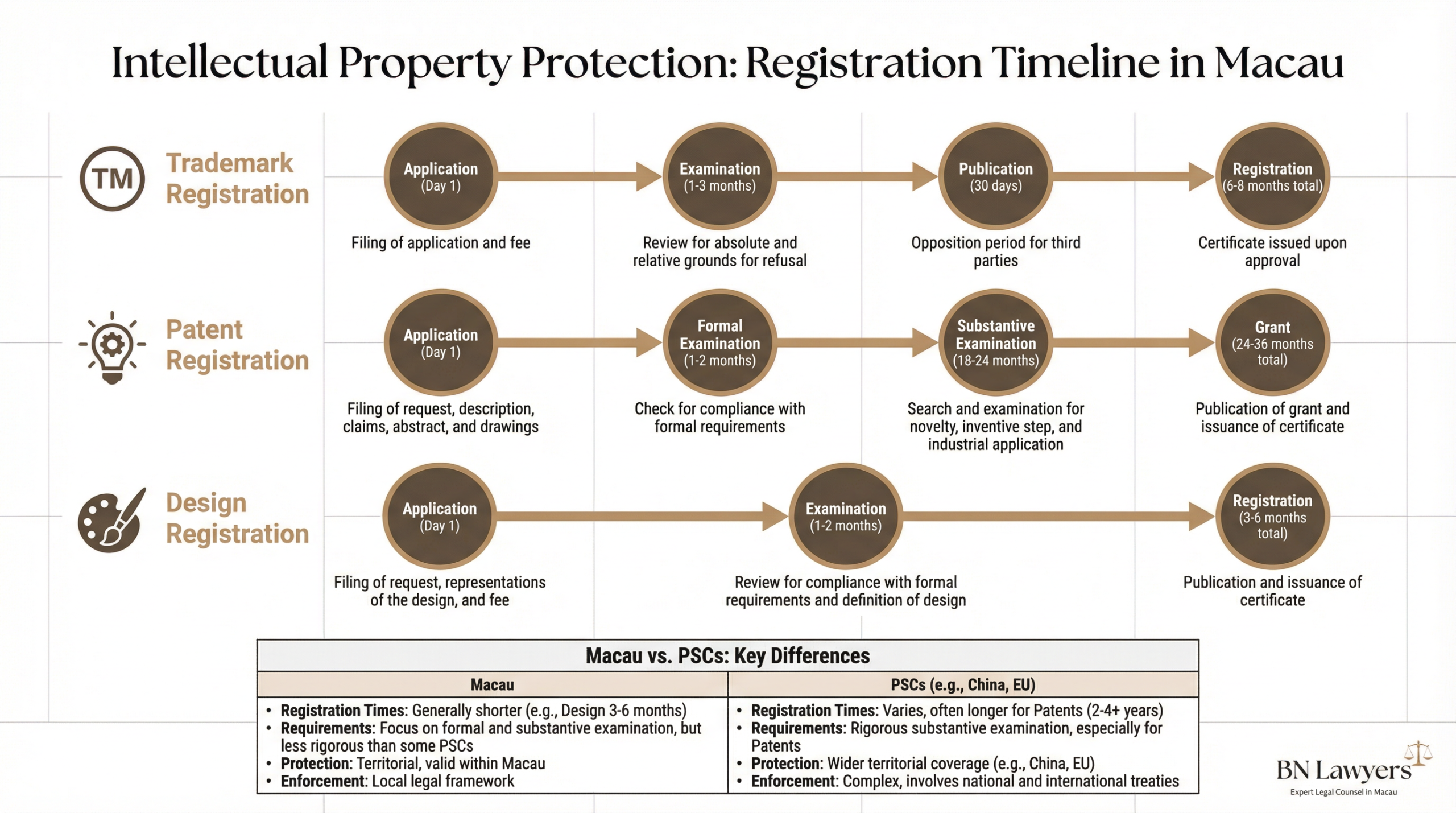
When Your brand is your promise to your customers. It’s what distinguishes you from the competition. Your trademark is the legal shield that protects that promise. It can be your company name, your logo, a slogan, or even the distinctive shape of your product. A successful Macau trademark registration is the first and most critical step in securing your brand’s identity in this market.
One of the biggest mistakes we see is companies assuming that their trademark registration in mainland China or Hong Kong covers them here. It doesn’t. Macau is a separate jurisdiction. You need to file separately in Macau to be protected. The good news is that the process is efficient, and once registered, your trademark is safe for seven years and can be renewed indefinitely.
2. Patents: Protecting Your Inventions
If you’ve invented a new product or a new process, a patent is what gives you a monopoly on that invention for a set period of time. It’s the reward for your innovation, and it’s what allows you to recoup your R&D investment. Macau’s patent system is modern and robust, offering protection for major inventions, smaller utility models, and the unique look of a product (designs).
An interesting feature of the Macau system is that you can extend a patent from mainland China or Portugal to cover Macau. This can be a very efficient way to secure your patent protection Macau if you already have a patent in one of those key jurisdictions.
3. Copyright: Your Creative Works are Automatically Protected
Copyright protects original creative works – things like articles, photographs, software code, and music. The great thing about copyright is that it’s automatic. The moment you create something original, you have copyright protection. You don’t have to register it, although registration can be a useful tool to prove your ownership in a dispute.
But it’s not just about enforcement. Arbitration gives you control. You can choose a neutral venue, pick an arbitrator with expertise in your specific industry, and decide that the whole process will be in English. And, crucially, it’s all private. Your dispute stays out of the public record, protecting your company’s reputation.

4. The Lusophone Connection: A World of Opportunity
This is where our expertise really shines. Macau’s unique position as the bridge between China and the Portuguese-Speaking Countries (PSCs) opens up a world of opportunities. But it also presents a complex IP challenge. Your strategy for IP protection Portuguese-speaking countries needs to be tailored to the specific laws of each country.
For Portugal and Brazil, you can take advantage of the Madrid Protocol for trademarks, which allows for a streamlined international application. But for other key markets like Angola and Mozambique, you’ll likely need to file separate national applications. Navigating this patchwork of different legal systems requires specialized knowledge of Lusophone IP law, and that’s exactly what we provide.
5. The Fight Against Fakes: An Ongoing Battle
Counterfeiting is a major threat to any successful brand, especially in the luxury goods sector. A comprehensive anti-counterfeiting strategy is essential. This involves more than just legal action; it’s a multi-front war.
You need to register your IP, record it with customs to enable border seizures, actively monitor online marketplaces, and be prepared to take swift legal action against infringers.
6. BN Lawyers: Your IP Guardians
At BN Lawyers, we’re passionate about helping our clients protect their great ideas. We’re not just paper-pushers; we’re strategic advisors. We can help you develop and implement a comprehensive IP strategy that covers Macau, the Greater Bay Area, and the Portuguese-speaking world.
We handle the full range of IP services, from trademark and patent registration to drafting licensing agreements and leading the charge in anti-counterfeiting actions. We understand that your IP is at the heart of your business, and we’re here to help you protect it.


1. What exactly is Intellectual Property, or IP?
Think of it as ownership of an idea or a creation. It’s not something you can physically hold, but it’s just as valuable. IP covers your brand name and logo (trademarks), your inventions (patents), your creative works like articles or photos (copyrights), and the unique look of your product (designs).
2. Why should I bother protecting my IP in Macau?
Because if you don't, someone else will use it. Protecting your IP is about stopping competitors from piggybacking on your hard work. It protects your brand, your reputation, and your income. And since Macau is a major gateway to the Greater Bay Area, getting your Macau trademark registration sorted is a critical business move.
3. How do I register a trademark in Macau?
You have to file an application with the Intellectual Property Department, which is part of the Macao Economic and Technological Development Bureau (DSEDT). They’ll check it, publish it to see if anyone objects, and if all goes well, your trademark gets registered.
4. How long does a Macau trademark last?
Your registration is good for seven years to start with. After that, you can renew it for another seven years, and you can keep renewing it indefinitely.
5. What kinds of patents can I get in Macau?
There are three main types here:
• Invention Patent: This is for a totally new product or process. It gives you 20 years of protection.
• Utility Patent: This is for a smaller improvement or a new practical shape. It lasts for 10 years.
• Design and Model: This protects the unique look of your product for up to 25 years.
6. Is my copyright automatic in Macau?
Yes. The moment you create an original piece of work – whether it’s writing, a photo, or a piece of music – you have copyright protection. You don’t have to register it, though it can be a good idea to have a public record.
7. How long does copyright protection last?
Generally, it lasts for the author’s entire life, plus another 50 years after they pass away.
8. If I have a trademark in mainland China, am I covered in Macau?
No, and this is a mistake many people make. Macau has its own separate legal system. You need to file a separate trademark application here to be protected.
9. What’s the Madrid Protocol?
It’s a very useful international treaty. It lets you file one single application to register your trademark in a bunch of different countries. It can be a real time and money saver. Portugal and Brazil are members, which is great for a Lusophone strategy.
10. How do I handle IP in the Portuguese-Speaking Countries (PSCs)?
It’s not a one-size-fits-all situation. Your strategy for IP protection Portuguese-speaking countries will vary. In Portugal and Brazil, you can use the Madrid system. But for others like Angola or Mozambique, you’ll likely need to file separate national applications.
11. What is ARIPO?
That’s the African Regional Intellectual Property Organization. It’s a central system for protecting patents and trademarks in a number of African countries, including Mozambique. It can be a smart way to get broader protection in the region.
12. What do I do if someone is copying my trademark in Macau?
Call a lawyer, fast. Your options include sending a formal “cease and desist” letter, suing them in court for damages, or getting customs to seize the fake goods at the border. You have to be proactive.
13. What’s a “trademark squatter”?
It’s someone who registers a famous brand name in a country where the real brand isn’t registered yet. They do it to try and sell the trademark back to the rightful owner for a big profit. The best way to beat them is to register your trademarks first.
14. Can I license my IP in Macau?
Of course. You can give another company the right to use your trademark, patent, or copyright in exchange for royalties. Just make sure you have a very solid licensing agreement in place to protect your brand and quality standards.
15. What’s a selective distribution agreement?
It’s a contract that luxury brands often use. It lets them limit who can sell their products, making sure they’re only sold in high-end shops that fit the brand’s image. It’s all about controlling the customer experience.
16. Are my business secrets protected in Macau?
Yes. Confidential business information and trade secrets are protected by law here. But you have to do your part – you need to show that you’ve taken reasonable steps to keep the information secret.
17. Do I need a lawyer for trademark registration?
You’re not legally required to have one, but I’d strongly recommend it. The process has a lot of technical steps, and a good IP lawyer who understands Lusophone IP law can help you avoid pitfalls and make sure your registration is solid.
18. What does it cost to register a trademark here?
The cost depends on how many categories of goods or services you want to cover. There are official government fees, and then there are the professional fees for your lawyer’s help.
19. Can I trademark a color or a sound?
Yes, you can. Macau allows for “non-conventional” trademarks like specific colors, sounds, or even 3D shapes, as long as you can prove they are distinctive and point back to your brand.
20. How can BN Lawyers help with my IP?
We handle the whole spectrum of IP work. We can take care of your trademark and patent protection Macau, manage your entire portfolio, draft your licensing agreements, and, if necessary, go after the people who are infringing on your rights. We’re here to make sure your great ideas stay yours.