When a Deal Goes Wrong
In the fast-paced world of international business, you can’t win them all. Sooner or later, a deal will go sour, a partner will fail to deliver, or a contract will be broken. It’s an unfortunate but inevitable part of doing business. When that happens, you need a smart strategy to resolve the dispute quickly, effectively, and without breaking the bank.
This is especially true in a place like Macau, which sits at the crossroads of international commerce. This guide is the cornerstone of our “Dispute Resolution” service hub. We’ll give you a straightforward, practical overview of your main options here: litigation (going to court), arbitration, and mediation. We’ll break down how each one works and give you our honest take on the pros and cons.
At BN Lawyers, we’re in the trenches with our clients every day on complex global disputes. Our team of litigation and arbitration specialists have seen it all, and we bring that real-world experience to the table. We’re not just Macau lawyers; we have a global perspective that’s essential for any cross-border dispute resolution.
1. The Three Paths: Litigation, Arbitration, and Mediation
When you’re facing a dispute, you have three main tools in your toolkit. Each one has its own distinct flavor, and the right choice depends entirely on your specific situation.
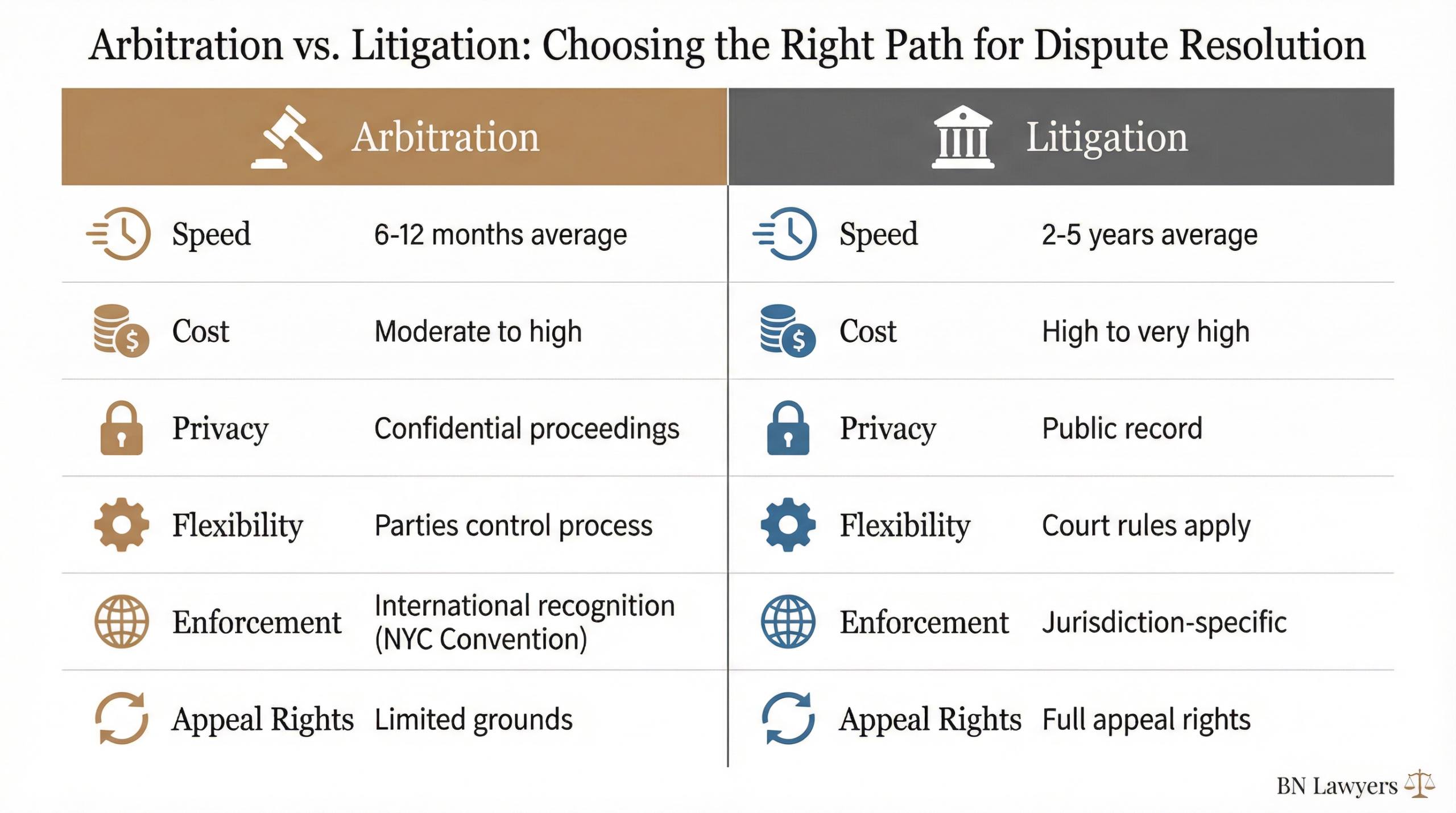
This is the traditional route – a formal, public battle in a courtroom. The process is governed by strict rules of procedure, and the final decision is made by a state-appointed judge. If you’re involved in litigation Macau, you need to be prepared for a process conducted in Chinese or Portuguese.
Think of this as a private, more flexible version of court. You and the other party agree to submit your dispute to one or more private individuals, known as arbitrators, who make a binding decision. It’s confidential, you can choose your decision-maker, and the final award is much easier to enforce internationally. This makes arbitration Macau a very attractive option for international players.
This is the least confrontational approach. A neutral third party, the mediator, doesn’t make a decision but helps you and the other side talk through your issues and try to reach a mutually acceptable settlement. We often recommend clients explore mediation services as a cost-effective first step.
2. Why International Businesses Lean Towards Arbitration
For any deal that crosses borders, arbitration has become the default choice, and for good reason. The key is a treaty called the New York Convention. This international agreement, signed by over 160 countries, means that an arbitration award made in Macau can be enforced almost anywhere in the world, and vice-versa. This power of international enforceability is something that court judgments simply can’t match.
But it’s not just about enforcement. Arbitration gives you control. You can choose a neutral venue, pick an arbitrator with expertise in your specific industry, and decide that the whole process will be in English. And, crucially, it’s all private. Your dispute stays out of the public record, protecting your company’s reputation.
3. The Strategic Importance of the Dispute Resolution Clause
Here’s a piece of advice we give every client: the most important time to think about dispute resolution is *before* you have a dispute. The dispute resolution clause in your contract is one of the most critical parts of the entire agreement. It’s where you and your business partner agree on the road map for what will happen if things go wrong.
Will you go to court in Macau? Will you opt for international arbitration in Singapore? Will you try mediation first? What law will apply? A poorly drafted clause can be a disaster, locking you into a long and expensive fight in an inconvenient location. A well-drafted clause, on the other hand, is a powerful tool that can save you an immense amount of time and money.
4. BN Lawyers: Your Partner in Conflict
Navigating a commercial dispute can be a stressful and distracting process. Our job is to take that weight off your shoulders. We have a dedicated team of dispute resolution lawyers with a deep understanding of both local and international disputes.
We can help you at every stage. We’ll work with you to draft rock-solid dispute resolution clauses for your contracts. When a dispute arises, we’ll give you a clear-eyed assessment of your position and help you devise a winning strategy. And whether you’re in court or at the arbitration table, we will fight your corner with skill, tenacity, and a relentless focus on getting the best possible outcome for your business.
1. What are my main options if I have a commercial dispute in Macau?
When a business deal goes south in Macau, you generally have three paths: litigation (going to court), arbitration, or mediation. Think of litigation as the traditional, public courtroom battle. Arbitration is more like a private trial you and the other party agree to, and it's a very popular option for arbitration Macau. Mediation is the softest approach, where a neutral person helps you both talk it out and find a solution you can both live with. It's all about finding the right fit for your specific problem.
2. What’s the real difference between suing someone and taking them to arbitration?
Litigation is what you see on TV – a public courtroom, a judge, and formal procedures. It’s part of the state system. Arbitration, on the other hand, is a private affair. You and the other party get to choose your own "judge" (the arbitrator) and set the rules. A huge plus for arbitration is that the final decision is confidential and, thanks to a treaty called the New York Convention, much easier to enforce in other countries. This makes it a go-to for any cross-border dispute resolution.
3. Why do international businesses seem to prefer arbitration?
It really comes down to practicality. An arbitration award is enforceable in over 160 countries, which is a game-changer for international deals. You also get to pick a neutral location and a decision-maker who might have specific industry expertise, which you don't get in a local court. Plus, keeping your business laundry out of the public eye is a major benefit.
4. What is this "New York Convention" I keep hearing about?
It's a cornerstone of international arbitration. In simple terms, it’s an international agreement that says all member countries will recognize and enforce arbitration awards from other member countries. It’s what gives arbitration its teeth and makes it so effective for international business.
5. Is an arbitration award really final?
Yes, for the most part. An arbitration award is meant to be the final word on a dispute. The grounds for challenging it in court are very narrow. This finality is a good thing – it means you can get a decision and move on, which is what most businesses want.
6. What are my options for arbitration in Macau?
Macau has its own well-regarded arbitration institutions that handle both local and international cases. They provide the framework, rules, and support to ensure a smooth process. So, if you're looking for arbitration Macau, you have established, reliable options right here.
7. What language are the courts in Macau?
This is a big one for foreign companies. The official languages in Macau courts are Chinese and Portuguese. If you're not fluent, this can be a real hurdle.
8. Can we use English in arbitration?
Absolutely. This is a key advantage of arbitration. The parties are free to choose the language of the proceedings, and English is very commonly used.
9. What exactly is mediation?
Mediation is a structured negotiation. A neutral third party, the mediator, helps you and the other side communicate and explore potential solutions. The mediator doesn’t make a decision; they guide you to your own agreement. We often recommend exploring mediation services as a first step.
10. If we agree on something in mediation, is it binding?
Yes. If you reach an agreement, you sign a settlement agreement. That’s a contract, and it’s fully legally binding.
11. What’s a dispute resolution clause?
It’s one of the most important clauses in any contract! It’s where you agree *before* any dispute happens how you will resolve it. Will you go to court? Will you use arbitration? Where? Under what law? Getting this clause right can save you a world of pain later.
12. What does the "seat" of arbitration mean?
The "seat" is the legal home of the arbitration. It’s a crucial choice because the law of the seat governs the arbitration process itself. Choosing a neutral and pro-arbitration location like Macau is a smart strategic move.
13. Can I get an urgent injunction in arbitration?
Yes, arbitrators can grant interim measures, like an injunction to stop the other party from doing something. For something truly urgent, though, it can sometimes be faster to go to the local courts, which can provide emergency relief to support an ongoing arbitration.
14. How are arbitration costs decided?
Costs usually include the arbitrator's fees, the institution's administrative fees, and your own legal costs. The tribunal will decide who pays what in the final award – it could be split, or the losing party might have to cover the winner's costs.
15. Is litigation in Macau always public?
Yes, court cases and judgments are generally public. If you have a sensitive business dispute, the confidentiality of arbitration is a much safer bet than public litigation Macau.
16. Can I enforce a Macau court judgment abroad?
It’s not as easy as enforcing an arbitration award. It depends entirely on whether Macau has a specific treaty for recognizing judgments with that other country. It can be a complicated and uncertain process.
17. What kinds of disputes are good for arbitration?
Almost any commercial dispute can be arbitrated. It’s particularly well-suited for international trade, construction projects, joint venture disagreements, IP licensing, and financial services disputes.
18. Do I really need a lawyer?
Honestly, yes. Whether you’re in court or in arbitration, the procedures are complex and the stakes are high. You need an experienced dispute resolution lawyer on your side who knows the Macau legal landscape inside and out.
19. What does an arbitrator do?
An arbitrator is like a private judge that the parties choose themselves. They listen to the arguments, review the evidence, and then make a final, binding decision (the award).
20. How can BN Lawyers help?
We live and breathe this stuff. Our team has years of experience in cross-border dispute resolution. We can help you draft a solid dispute resolution clause, advise you on the best strategy when a dispute arises, and represent you forcefully in either arbitration or litigation. Our goal is simple: to protect your interests and get the best possible result for your business.